RESEARCH ARTICLES
OBSERVING AND REPORTING PAIN
Observing and Reporting Pain: Evaluating an Educational Workshop to Assist Family Caregivers to Identify and Communicate Pain in Persons with Dementia

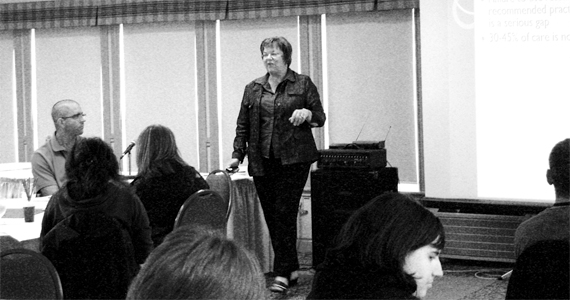
Background: With a previous Adult Learning Knowledge Centre/Canadian Council on Learning grant, we developed an educational toolkit for teaching people how to recognize pain in their family member with dementia. The toolkit contains digitalized audio-video presentations, promotional materials, participant information packs and workshop evaluation forms for organizations to download and customize. The toolkit also contains extensive evidence –based reference materials and resources in senior’s education and pain related to dementia. The intent is that community organizations, with limited access to healthcare professionals, can provide useful workshops for their members. This matters because family caregivers, often seniors themselves, lack the health literacy to deal with the increasing reality of assuming responsibility for managing spouses and aged parents with dementia in the home setting.

Aim: This project will field-testing the toolkit for effectiveness within both rural and urban community setting. Specifically we will examine: 1) if the toolkit can be applied independently by a community group to deliver the pain and dementia workshop, and 2) does knowledge about pain and dementia and caregivers’ perceptions of self-efficacy for managing pain improve consequent to participation in the workshop?

 
EDUCATION AND TRAINING
Education and Training
The first CDKTN theme focuses on trainees (students, researchers and practitioners) in studies and disciplines relevant to dementia. It includes development of specific training programs and opportunities for researchers and health practitioners in knowledge translation and exchange (KT&E) and funding opportunities and research projects for the study of KT in dementia research.
Education and Training Theme activities include:
  • Curriculum development
  • Knowledge translation training opportunities:
  • Funding opportunities for knowledge translation training
  • Pilot research projects
 
VISITING RESEARCH SCHOLAR IN DEMENTIA KNOWLEDGE TRANSLATION
VISITING SCHOLAR POSITION
 
Visiting Research Scholar in Dementia Knowledge Translation
 
The Education and Training theme of The Canadian Dementia Knowledge Translation Network (CDKTN) project at UBC is seeking Visiting Scholars whose interests lie at the intersection of dementia and knowledge translation. The program funds 2-6 month fellowships for investigators, academic faculty and clinicians to conduct research, deliver other scholarly products such as case reviews and books, or produce innovative multimedia materials in dementia or knowledge translation research in Canada. This is an outstanding opportunity to participate in world class research in dementia KT and interact with high calibre scholars at the Neuroethics Core & the UBC Hospital Clinic for Alzheimer Disease and Related Disorders.
 
Applicants for these competitive fellowships must hold an MD and/or PhD degree. Scholars selected for the Vancouver-based program will receive both travel support and a monthly stipend. Openings are currently available and applications will be reviewed upon receipt.
 
To apply, please submit a short statement describing your interest in the scholarship and proposed project, a cover letter and CV c/o Janice Matautia: matautia@mail.ubc.ca

http://www.lifeandminds.ca/uploads/CDKTN%20scholar%20position%20job.pdf
 
KNOWLEDGE TRANSLATION AND EXCHANGE THINK TANK

The Canadian Networking the Networks initiative represents a Canadian partnership to accelerate knowledge transfer to practice. This initiative brought together approximately 80 experts and stakeholders in the fields of mental health, dementia, aging and knowledge transfer and exchange in the Seniors' Mental Health and Dementia Accelerating Knowledge Transfer and Exchange Think Tank, A Canadian Networking the Networks Initiative, on Sunday March 29th and Monday March 30th, 2009 at the Élisabeth Bruyčre Research Institute in Ottawa, Ontario. The participants of this Think Tank helped to meet the specific goals and objectives of the initiative including:

  • To identify and engage local, provincial, and national organizations involved in knowledge exchange in the area of seniors’ mental health and/or dementia in a partnership.
  • To highlight the successful exchanges and to raise the profile of seniors’ mental health and dementia for ongoing support.
  • To understand how strategies in knowledge exchange from mental health and dementia sectors can be applied to all other sectors of senior health.
  • To create a Community of Practice for knowledge exchange in seniors’ mental health, dementia, and a knowledge bank.
  • To use technology and creative communication systems to create a Community of Practice and engage in collaborative initiatives across the country.
  • To streamline the knowledge exchange processes in the field of seniors’ mental health and dementia to increase the knowledge and power of stakeholders and advocates.

In addition, the outcomes of this Think Tank will also be used to help the Seniors Advisory Committee provide guidance to the Mental Health Commission of Canada as they initiate the national Knowledge Exchange Centre.

In preparation for the Think Tank, CDKTN contributed to the development of the “KTE Knowledge Bank” (www.kteknowledgebank.ca), and interactive database of searchable resources that highlight strategies and processes that may be effective in supporting knowledge exchange, diffusion, management, mobilization, transfer, and translation to be applied in the seniors' mental health and dementia sectors. The data collected was combined and captured in a database, and results have been outlined and distributed in “The Road Ahead: Knowledge Bank Progress Report” (Harris & Lusk, 2009).

The Accelerating Knowledge Transfer and Exchange Invitational Think Tank was sponsored by the Canadian Institutes for Health Research, Institute of Neurosciences, Mental Health and Addictions and the Public Health Agency of Canada, Division of Aging and Seniors, and is being coordinated through the Canadian Coalition for Seniors’ Mental Health (CCSMH). Other partnering agencies include:

  • Alzheimer Knowledge Exchange
  • Canadian Dementia Knowledge Translation Network
  • Mental Health Commission of Canada
  • National Initiative for the Care of the Elderly
  • Seniors Health Research Transfer Network
 
CANADIAN DEMENTIA RESOURCE AND KNOWLEDGE EXCHANGE (CDRAKE)

WHAT

The Canadian Dementia Resource and Knowledge Exchange (CDRAKE) is a free, virtual network that brings together the best and brightest in dementia care to:

· Support the learning needs of people seeking practice change

· Facilitate quick and easy access to the best knowledge for continuous quality improvement

· Stimulate, support and share innovations

· Build and strengthen collaborative partnerships between stakeholders

· Foster direct links between knowledge users and producers

WHY

As a member of CDRAKE you will be:

· Connected to upcoming online or in-person opportunities for knowledge exchange, innovations in dementia care and links to stakeholders

·  Invited to join topic-specific national Communities of Practice where you can connect with people who share a common passion

·  Offer ways to showcase your leadership and advancements related to dementia care

·  Networked with thousands of other knowledgeable care providers, researcher, educators and policy makers working in the field of dementia care

HOW

To get connected with dementia innovation across Canada: Sign Up Here

CONTACT

Dr. Ken LeClair, CDRAKE Lead
leclairk@providencecare.ca 

Megan Harris, KT Planning & Development Lead
harris@gestaltcollective.com

Sarah Clark,
KT Resource Mobilization Lead
clark@dementiaknowledgebroker.ca

Elizabeth Lusk, KT Conceptual Design Lead
lusk@gestaltcollective.com

 
DRIVING AND DEMENTIA
Driving and Dementia

Background: Currently in Nova Scotia, over 5,000 people with Alzheimer’s disease (AD) continue to drive.

Due to population aging, by the year 2030 one in every 25 drivers over the age of 65 will have dementia.

Alzheimer’s disease impacts driving by:

  1. Affecting attention
  2. Reaction time
  3. Judgment, and
  4. Coordination.

Although some people with AD are safe drivers, even the mild to moderate stages of the disease carry a significantly increased risk of motor vehicle crash, with consequences for safety of the driver, passenger, and community.

One of the foremost public health dilemmas surrounding driving safety is how to promote the independence of safe drivers while facilitating driving cessation in those with dementia who are no longer safe to drive.

The Canadian Medical Association (CMA) recently issued revised guidelines for the assessment of driving in dementia, which is designed to provide a unified physician approach to assessing fitness to drive in people with dementia; however, this guideline does not offer conclusive answers for case-by-case usage.

All but three Canadian provinces (including Nova Scotia) require physicians to report potentially unsafe drivers to provincial licensing authorities. The lack of formal training, absence of a conclusive clinical fitness-to-drive evaluation and current status of discretionary reporting, may all contribute to primary care physician’s lack of confidence in assessing and reporting fitness to drive, highlighting the need for physician education and further resource development.

Aim: In order to address driving cessation in dementia a 30-second television public service announcement (PSA) about driving safety in AD will be developed that will aim to increase awareness of the problem and ultimately lead to an increase in caregiver requests for primary care physicians to discuss driving cessation. As well, a website designed for primary care physician use consisting of in-office tools and forms, as well as Nova Scotia specific links to community resources and relevant materials. Resources will also be available to caregivers, as well as other stakeholder groups and healthcare professionals to provide education to patients and family members.

 
CAREGIVERS FOR THE ELDERLY AT HOME: A FIVE STEP APPROACH TO REDUCING YOUR STRESS

Caregivers for the elderly at home: A five step approach to reducing your stress  

Background: “Being a caregiver simply means ensuring the well-being and quality of life of a loved one who needs support.”

Did you know?...
  • 90% of the assistance and care provided to elderly people who suffer from health problems and a loss of independence is provided by families.
  • In the majority of cases, the responsibilities of caring for an elderly loved one are assumed by women, and very often these women are the spouses, who are themselves elderly and vulnerable.
  • Among elderly male caregivers, 60% spend 12 hours a day or more doing activities related to caring for their spouse, which works out to a minimum of 84 hours a week.

Studies have shown that caregivers carry a heavy psychological burden. They feel like they’re never doing enough or are powerless against all the challenges they face. That’s why it’s essential that they learn how to manage their new role in such a way that they can maintain a healthy lifestyle.

Aim: Caregivers can improve their well-being by using certain stress management techniques. This document proposes a five-step approach to help you gain a different perspective and make the most of your situation.

This stress management approach was developed by the research team of the Desjardins Research Chair in Nursing Care for Nursing Care for Seniors and their Families. The brochure is disseminated with the support of VON Canada.

(photo by zweettooth)